RV content & UX strategy
This phase of our long-term partnership focused on evolving Transwest’s content strategy through deliberate UX architecture and system design.

Evolution of partnership
We’ve partnered with Transwest for many years, designing and developing much of their online presence. That work includes a substantial portion of their website content, built long before generative AI reshaped the content landscape.
The foundation was strong, grounded in genuine expertise and experience. But as search behavior evolved and Transwest’s audience expanded, the structure surrounding that expertise no longer reflected how people actually research, compare, and shop for RVs.
Services
UX Research & Design
Team Augmentation
Deliverables
Curated User Journeys
Custom Filament CMS
Creator Pages
Resource Hub
Content Calendar
SME Content Production Process
How AI has changed the SEO game
Today, search engines and AI-generated results increasingly reward structured experiences and clear signals of expertise. Adding more content wouldn't have solved Transwest's underlying issue. The experience itself needed to be reconsidered, so our team came together to reimagine how RV knowledge could be organized and surfaced.
Identifying opportunities to elevate user engagement
To understand where performance had shifted, we analyzed trends across several topics where Transwest had historically performed well. Organic visibility had softened in several high-value areas, and while some ranking changes mirrored broader economic shifts, the pattern couldn’t be entirely attributed to RV market trends.
Competitor sites featured neatly structured content, clearer internal pathways, and stronger authority signals that frankly, outperformed Transwest. This gap presented a real opportunity to communicate Transwest's expertise more clearly, to users and to the systems now interpreting it.
Pressure-testing the opportunity from every angle
Rather than act in isolation, we brought the entire team together to explore the opportunity. Developers, designers, QA, account and project managers, and content strategists spent focused time together, identifying opportunities to improve engagement.
Some ideas were clearly grounded in established UX research, others in cross-functional insights and hands-on experience with the platform, and still others in unrelated markets and experiences we thought might just work. After this meeting, we put together a presentation of potential ideas for the Transwest team to evaluate what would deliver the greatest impact.
Multifaceted content strategy
The gaps we identified were interconnected, so the strategy needed to be multifaceted as well. We needed to rethink how content, design, publishing workflows, and development worked together across the site.
What followed was an elegant series of improvements built around the full RV lifecycle. Each supports the others, creating a clearer, more navigable experience that enhances customer usability and reinforces the structure and authority signals that search engines and AI results rely on.
Turning blog posts into guided journeys
Over time, Transwest’s blog had grown into a substantial library of educational resources, product insights, and travel inspiration. But like many longstanding blogs, it functioned primarily as an archive. Content was organized chronologically, leaving readers to search and piece together related information on their own.
So, we reframed the blog's role within the broader content strategy. Instead of treating each article as a standalone asset, we organized content around the way people actually research, compare, and make decisions throughout RV ownership.
RV basics, maintenance, travel inspiration, gear and accessories, RV life, and shopping for an RV now serve as core content pillars. These categories reflect the natural progression of considerations that shape the RV buying and ownership process, transforming the blog from a “collection of posts” into a structured journey.
Designing resource hubs for exploration
Reorganizing content into lifecycle categories created structure, but experience is about a lot more than structure alone. To make that organization meaningful, we designed dedicated resource hubs that guide readers through each category, bringing together related articles, videos, and tools within a shared context.
Instead of a chronological feed or loosely related tags, these hubs present curated pathways that reflect how people research, compare, and decide over time. Those intentional connections create clarity for readers while also reinforcing relationships between topics.
As readers move through the hubs, broader themes naturally flow into more specific questions. Lifestyle segments off-grid, luxury, and full-time living add another layer of context, helping customers visualize themselves within the journey. This cohesive, navigable experience builds confidence and reinforces Transwest’s expertise.

Extending engagement with user accounts
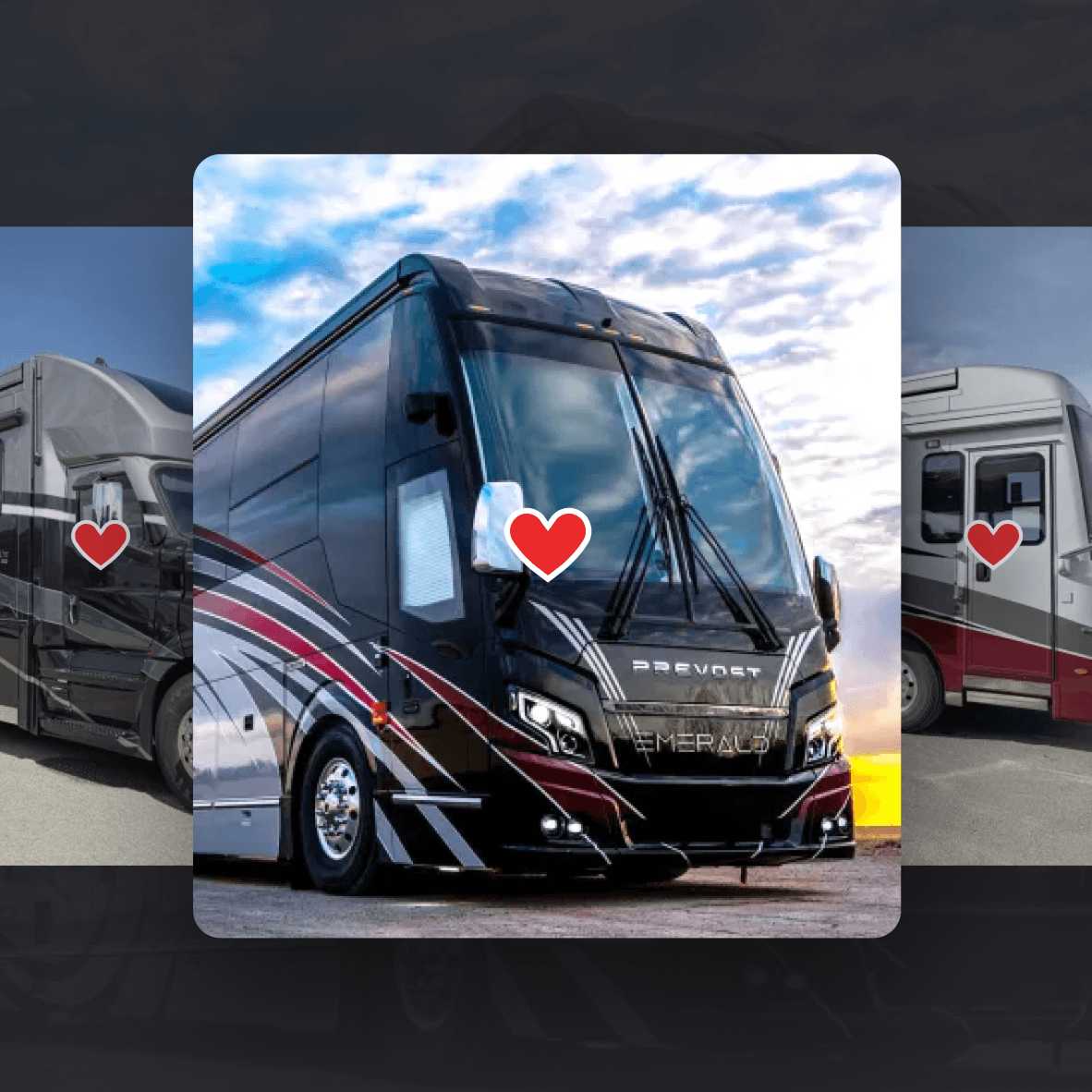
As the content experience became more structured, we designed features to support deeper engagement over time. User accounts allow visitors to “favorite” vehicles, save resources, and receive related content tailored to their shopping and RVing interests. They can also save search settings, making it easy to return to their RV hunt without starting over.
With these tools in place, users can forge their own path through products, educational materials, and saved searches. The experience becomes more continuous and personalized, reinforcing the lifecycle-driven approach that shapes the broader site.
Building an expert-powered content engine
For sustainable improvement, the publishing process needed clearer direction. Using the newly established lifecycle categories as strategic pillars, we conducted a content gap analysis across related keyword clusters. That work informed a roadmap of more than 200 potential topics intended to deepen coverage across RV ownership stages and lifestyles.
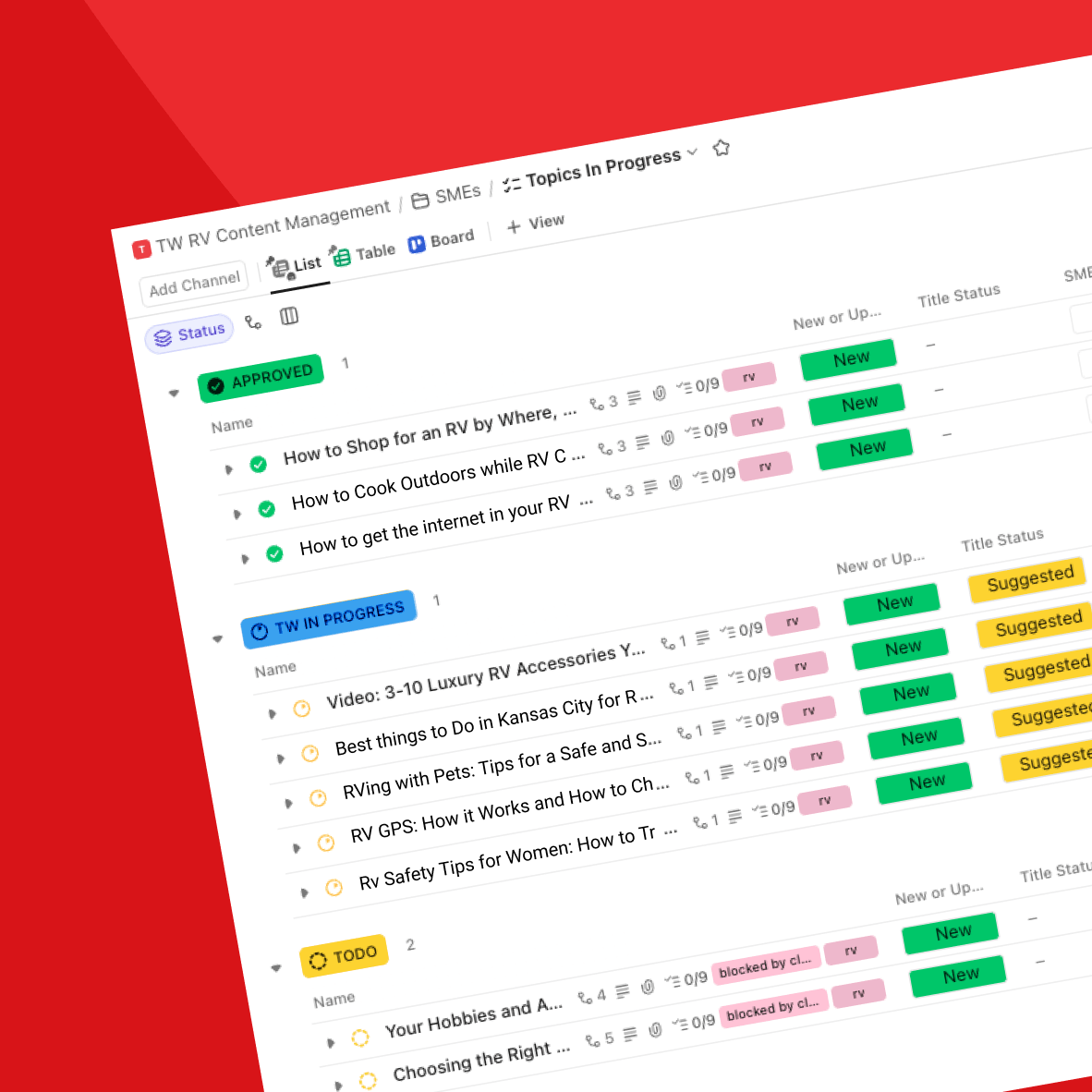
Because that expansion needed to reflect real-world experience, we also formalized a collaborative workflow with Transwest’s subject matter experts (SMEs). Within our project management software (ClickUp), we created a dedicated space for meetings, briefs, drafts, and editorial review. SMEs can write or produce their own blog and video content, approve briefs for our content team to develop, or claim and refresh existing pieces, with final approval before publication.
This collaboration allows expertise to move from conversation to publication efficiently, without sacrificing clarity or accuracy. As a result, content development is coordinated rather than reactive, and each new piece strengthens the entire system.
Activating campaigns through promotions pages
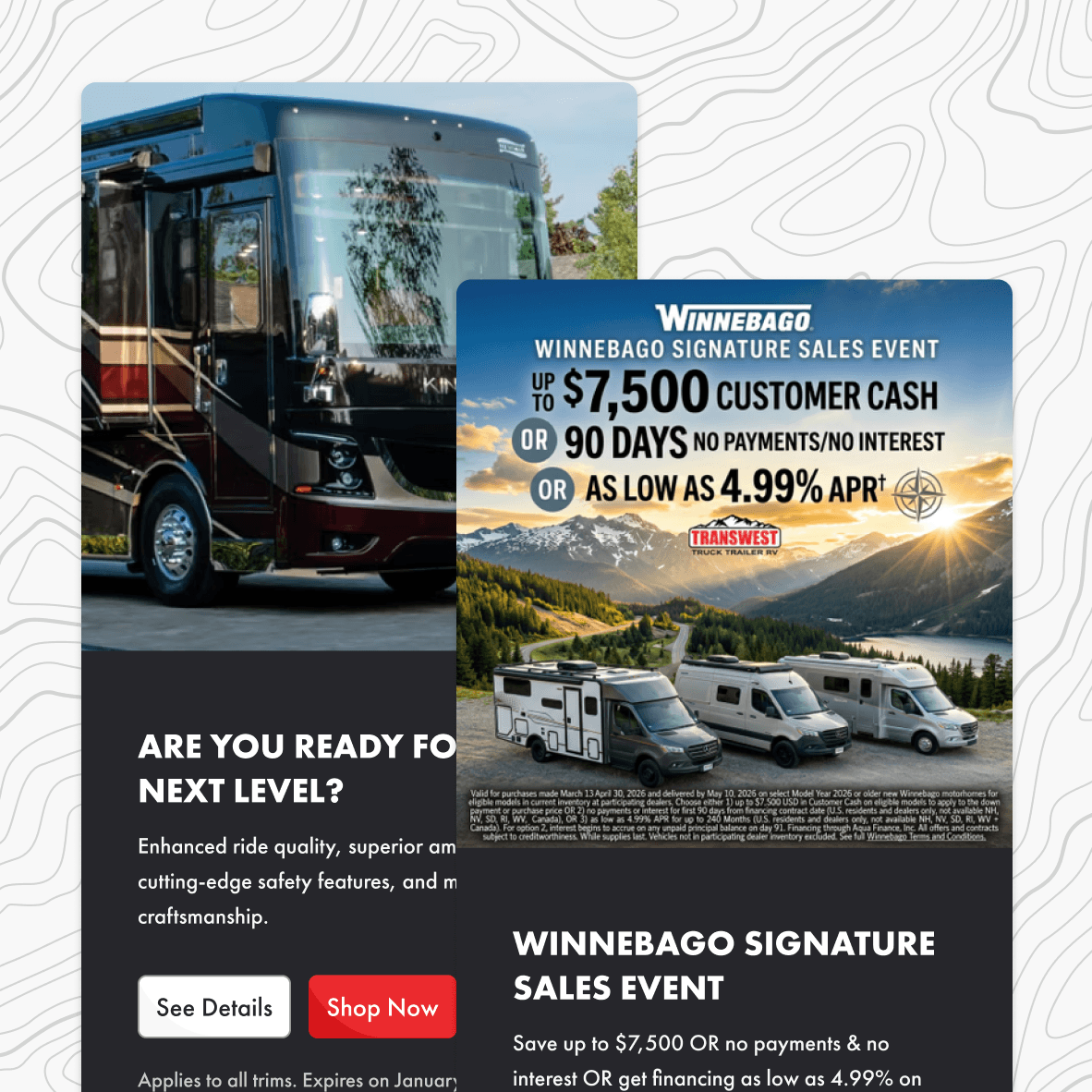
As Transwest’s content ecosystem evolved, the marketing team needed a repeatable way to spotlight seasonal sales and featured inventory.
To support that effort, we built a scalable promotions framework for the team to create dedicated landing pages for specific products, campaigns, or ideas. No longer one-off builds, these pages use modular components to showcase curated inventory, related resources, expert insights, and clear calls to action within a consistent brand experience.
Elevating expertise
Transwest’s expertise has always started with its people. Sales professionals and product specialists field highly detailed questions about RV technology and plumbing, compare chassis, solar, and battery options, and guide customers through complex decisions between equally great models every single day. That depth of knowledge alone warranted clearer online visibility, especially within the browsing experience.
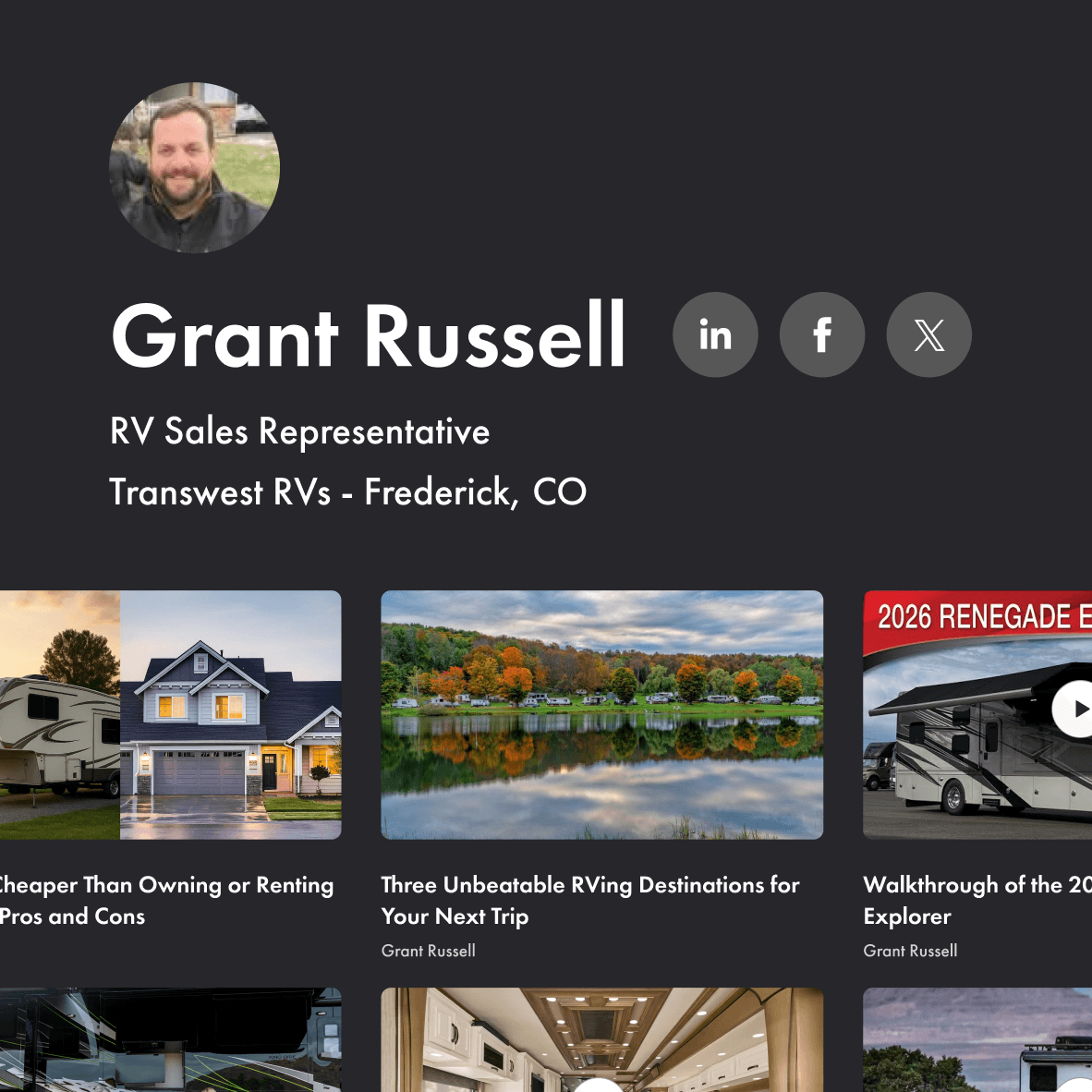
Clear authorship matters for readers and for how that expertise gets recognized more broadly. To better showcase expertise, we designed dedicated pages that consolidate each Transwest SME’s blogs, walkthrough videos, and educational resources in one place. Contributors now have a visible body of work attached to their name that readers can explore. Authorship is now intentional rather than incidental, reinforcing authority for users while strengthening the signals search engines and AI rely on.

Development that supports the strategy
Before the content restructuring began, we had already improved the publishing experience by migrating from Nova to Filament within Laravel. The shift was immediately helpful for model page production, which previously required manual image uploads, filtering logic, and repeated inputs across multiple backend locations.
That decision became even more valuable when we later introduced lifecycle categories, topics, and lifestyle segments. Categories and subtopics now function as dynamic filters, allowing content to surface across resource hubs, expert pages, model pages, and vehicle display pages without duplication.
This interconnectedness also strengthens internal linking and contextual relationships sitewide, helping users and search systems better understand how Transwest’s products and ideas relate to one another. With a more flexible content management system (CMS) in place, updates are faster and easier, even as the content grows. The technical foundation continues to support the strategy.
Preliminary outcomes
While measurable gains will continue to build over time, the operational and structural improvements are already in place.

SME-driven articles are now published through the new collaborative process

Lifecycle categories and lifestyle filters are fully implemented, improving discoverability

Backend updates, particularly for model pages, are faster and more consistent following the CMS migration

A structured foundation is in place to strengthen long-term search and AI visibility as content depth continues to expand

